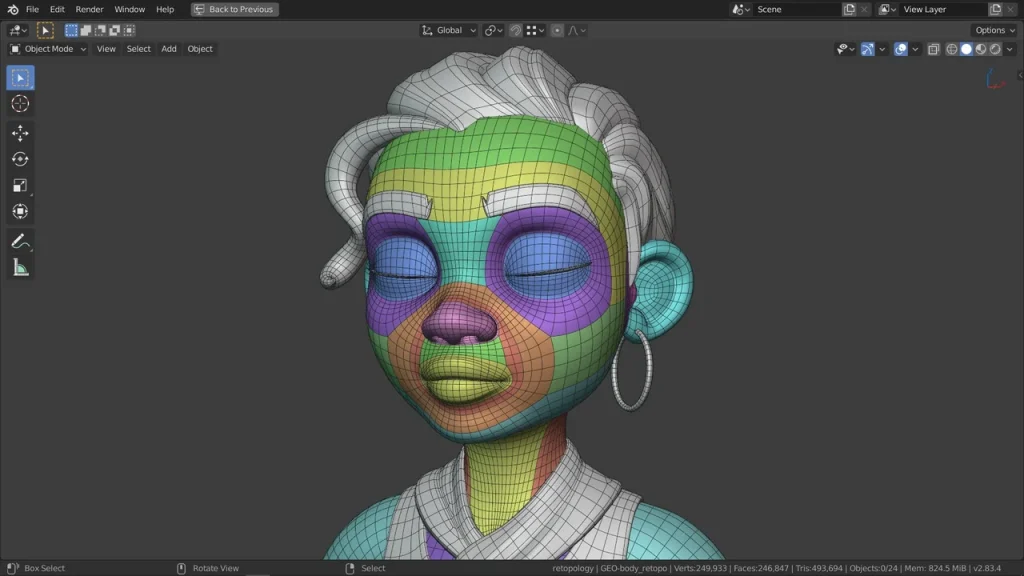
Optimizing 3D assets for games means keeping visual quality while lowering their cost to render. The main tools are sensible polygon budgets, levels of detail (LODs), texture atlases and compression, fewer materials and draw calls, and baked detail in normal maps instead of geometry.
If you do it yourself, our Null Labs tool Null Game Toolkit generates UCX collision meshes and LODs in Blender and batch-exports game-ready FBX.
In the dynamic world of gaming, performance is paramount. Whether you’re developing an AAA title or an indie game, optimizing your models for performance can significantly impact the player experience. From reducing load times to ensuring smooth frame rates, every aspect of optimization counts. In this blog post, we’ll explore some essential tips and tricks for optimizing game models to deliver a seamless and immersive gaming experience.
What are polygons in games?
Polygons are the flat faces, almost always triangles once in the engine, that make up every 3D model in a game. The GPU draws each triangle every frame, so the polygon count of a model, its “poly budget”, is one of the first things to plan when optimizing for performance.
- Why triangles? A triangle is always flat, so the graphics hardware can render it predictably. Quads used while modeling are split into triangles on export.
- Polygons vs. vertices. Engines care about vertex count too; hard edges and UV seams split vertices, so a model can cost more than its triangle count suggests.
- How many is too many? There is no single number; it depends on platform, how close the camera gets and how many copies are on screen. Set a budget per asset type with your programmers before modeling, and confirm it with in-engine profiling.
Polygon reduction
Polygon reduction is a basic optimization approach for game models. You can cut the polygon count of your models without losing important detail by simplifying the geometry. This procedure can be automated with the use of tools like Blender’s Decimate modifier or third-party programs like Simplygon and Instant Meshes, letting you balance performance and visual accuracy.
LOD (level of detail) implementation
Implementing LODs is crucial for efficiently managing the level of detail based on the distance between the camera and the object. By providing multiple versions of the model with varying levels of detail, you can dynamically switch between them as needed, reducing the rendering workload. Unity and Unreal Engine offer built-in LOD systems that streamline this process, optimizing performance without sacrificing visual quality.
A practical optimization order
If a scene is slow, check in this order:
- Profile in engine to see whether the CPU (draw calls) or GPU (pixels, overdraw, triangles) is the bottleneck.
- Merge materials and use atlases or trim sheets.
- Add LODs and culling.
- Reduce triangles on the heaviest assets.
- Resize and compress textures for the platform.
Fixing the real bottleneck first saves rework.
Bake detail instead of modeling it
Fine detail such as bolts, seams and panel lines can be sculpted on a high-poly model and baked into a normal map on a low-poly mesh. The silhouette stays clean and the surface still reads as detailed. Clean retopology and UVs make the bake work; see a production guide to retopology.
Texture optimization
Texture optimization plays a major role in game performance. Texture atlases, mipmapping, and texture compression methods (such as DXT, ETC, or ASTC) can help you save GPU resources and limit memory usage. Also consider optimizing texture resolution and removing unnecessary detail to balance visual quality and performance.
Mesh batching and instancing
By grouping several objects into a single batch or instance, these optimization approaches minimize draw calls. This results in a significant reduction of CPU overhead and more effective rendering. Unity and Unreal Engine provide tools and APIs for mesh batching and instancing, so developers can maximize efficiency without sacrificing visual quality.
Optimized animation and rigging
Good animation and rigging can help games run more smoothly overall. To lessen CPU strain during animation playback, use bone culling, reduce the number of bones per character, and use simple, optimized bone structures. Also consider techniques like skeletal mesh merging to improve rendering and animation efficiency.
Culling techniques
You can skip rendering objects that are hidden behind other geometry or outside the camera’s field of view by using occlusion culling and frustum culling. Rendering only what the player can see reduces the load on the GPU and boosts efficiency, particularly in detailed scenes.
Asset bundling and streaming
These two strategies are crucial for performance optimization in massively multiplayer games with vast environments. Your game components should be organized into manageable bundles and loaded dynamically in response to scene requirements or player proximity. This strategy reduces loading times and memory use, facilitating fluid gameplay and exploration.
Related: Game art and animation · BLACKWOOD · A production guide to retopology
05 / Questions
Ask us anythingBefore you
get in touch.
It depends on scope: the number of assets or shots, the level of detail and the delivery formats. We send a quote after reviewing your brief and bill in USD by milestone.
It depends on scope; we confirm a schedule after the brief. Larger or more detailed projects are split into milestones so you can review progress along the way.
Optimized models are usually delivered as FBX or glTF with LODs, baked texture sets and clean UVs, ready for your engine. We confirm the exact formats and specs in the brief so the files fit your pipeline.
You share the source models, target platform and performance budget. We retopologize, bake and set up LODs, test in engine, and hand over the optimized files with notes.
Clients officially own the final files once payment clears. Null Station keeps the right to show the work in its portfolio.
The triangles that form every 3D model on screen. Fewer triangles render faster, which is why game models use polygon budgets, LODs and normal maps.
No. If the game is limited by draw calls, texture memory or overdraw, cutting triangles helps little. Profile first, then fix the bottleneck.
You can build them by hand, or use our Null Labs add-on Null Game Toolkit, which generates LODs and UCX collision and batch-exports FBX. For production help, see 3D modeling services.