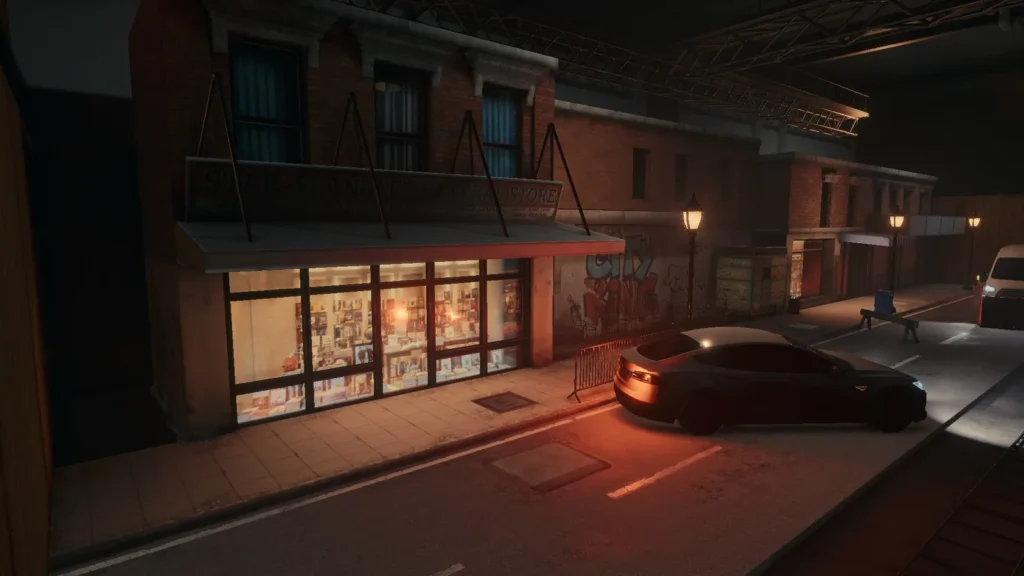
An anamorphic display video uses forced perspective on a corner or curved LED screen so that, from one viewing point, objects appear to leap out of the building. Making one starts with the screen’s exact geometry and the main viewing angle, then a 3D scene rendered for that camera.
If you do it yourself, our Null Labs tool Null Cast streams live webcam video or screen captures onto Blender meshes.
What is an anamorphic projection?
An anamorphic projection is an image deliberately distorted so it only looks correct from one viewpoint. From that spot the distortion cancels out and the image appears three-dimensional; from anywhere else it looks stretched. Anamorphic billboards use the same idea on corner LED screens, so objects seem to break out of the building.
What is Anamorphic Illusion?
Anamorphic illusion is an ancient art form that has recently resurfaced in the LED display and video content industry. It involves creating distorted projections that require viewers to occupy specific vantage points or use special devices to perceive recognizable images. In the context of motion graphics and VFX, anamorphic illusions allow us to watch video content on displays from certain angles, creating the illusion of a 3-dimensional environment.
Historical Roots of Anamorphic Techniques
Cave Paintings: The earliest documented use of anamorphic techniques dates back to cave paintings during the Stone Age. These paintings utilized the oblique angles of cave walls to create illusions.
Renaissance Art: During the Renaissance, artists like Leonardo da Vinci and Hans Holbein the Younger experimented with anamorphic illusions. Holbein’s famous painting “The Ambassadors” features a distorted grey slash that resolves into a human skull when viewed from a specific angle.
17th Century Revival: Anamorphic illusions resurfaced in the 17th century in Italy and China. For instance, the Church of Sant’Ignazio in Rome boasts a ceiling where Andrea Pozzo created the appearance of a dome on a flat surface.
World War I: Photographer Arthur Mole used anamorphic techniques during World War I to create patriotic images from massive groups of soldiers. When seen from a tower, these gatherings resolved into recognizable pictures.
Modern Applications of Anamorphic Illusions

Everyday Life
IMAX Theaters: IMAX screens often utilize anamorphic techniques to enhance the cinematic experience.
Road Signs: Ever noticed the words “Bus Lane” on the road? Anamorphic illusions make them legible from specific angles.
Street Art: Social media is filled with images of street art that play with anamorphic effects, causing viewers to do double takes.
How a 3D anamorphic billboard video is made
- Get the screen’s exact geometry. Pixel resolution, physical size and the angle of each face (corner, curve or flat). A 3D model of the screen is built from the spec.
- Pick the sweet spot. The illusion works for one main viewing position, usually where most people stand or approach. Everything is designed for that eye point.
- Match a 3D camera to that viewpoint. The virtual camera sits at the sweet spot, at real-world height and distance from the screen model.
- Build and animate the scene for that camera. Objects that “pop out” are animated toward the camera; a fake frame or box inside the screen adds depth.
- Project and unwrap to the screen’s pixel map. The camera’s view is projected onto the screen model and baked out to the flat pixel layout the LED controller expects.
- Test in a preview and on site. Check from the sweet spot and from off-angles, and adjust brightness and contrast for daylight.
Forced perspective vs. anamorphic
Forced perspective uses scale and placement to fake distance; anamorphic content uses projected distortion that resolves from one viewpoint. 3D billboards combine both.
See our anamorphic display project and our Experiences and R&D work.
If you mean anamorphic lens footage
“Anamorphic” also describes footage shot with anamorphic lenses, which is a different thing from 3D LED billboards. If that is what you are after, here is the basic workflow:
Aspect Ratio: Start by shooting your footage in a standard aspect ratio (e.g., 16:9). Anamorphic lenses squeeze the image horizontally, so you’ll need to desqueeze it later.
Editing Software: Import your footage into video editing software (such as Adobe Premiere Pro or Final Cut Pro).
Desqueezing: Right-click on the clip in the timeline and select “Clip Attributes.” Under “Pixel Aspect Ratio,” set it to “1.3x Anamorphic” or “1.5x,” depending on your desired aspect ratio. This step ensures your footage displays correctly.
Chromatic Aberration: Add adjustable chromatic aberration to mimic the imperfections of anamorphic lenses. This effect enhances the illusion.
Bokeh Effects: Create oval-shaped bokeh effects to replicate the unique lens flares associated with anamorphic footage.
Color Grading: Apply color grading to achieve the cinematic look often seen in anamorphic films.
Remember, anamorphic illusions are all about perspective. Experiment, find your vantage point, and create captivating videos that leave viewers in awe. 
Need one made? Talk to us about an anamorphic display project.
Types of Anamorphic Illusions
Anamorphic illusions come in a variety of forms, each with its own unique way of tricking the eye. Let’s know some of the most common types:
Cylindrical Anamorphs: Imagine a distorted image that only reveals its true form when viewed from the side of a cylinder. That’s the magic of cylindrical anamorphs. These illusions rely on the curved surface of the cylinder to correct the distortions in the artwork, making a recognizable image appear.
Mirror Anamorphs: Here, a strategically placed curved or cylindrical mirror becomes the key to unlocking the illusion. A seemingly random jumble of lines on a flat surface transforms into a coherent image when reflected in the mirror at a specific angle. The mathematics of reflection plays a crucial role in creating these mind-bending effects.
Multi-Perspective Anamorphs: Take a step back, then another, and watch the image change! Multi-perspective anamorphs are designed to be viewed from multiple vantage points, each revealing a different aspect of the hidden image. This type of illusion plays with the concept of perspective, forcing viewers to move around to grasp the complete picture.
Street Art Anamorphs: Step out onto the streets and prepare to be surprised! Street art anamorphs take the illusion outdoors, transforming sidewalks and walls into mind-bending experiences. These large-scale artworks often rely on specific viewing angles, like a designated spot on the street, to reveal their hidden image. They add a playful and interactive element to urban spaces.
These are just a few of the many ways anamorphic illusions can twist our perception. From cylindrical wonders to street art spectacles, each type offers a glimpse into the fascinating world of visual deception. Stay tuned as we explore the exciting world of creating your own anamorphic illusions!