
Field notes / Experiences & R&DPhysical controls.
Virtual worlds.Explore the project
Experiences & R&DVirtual worlds.Explore the project
Tractor Simulator Rig
Research · Prototype · Working installation
Services / 03
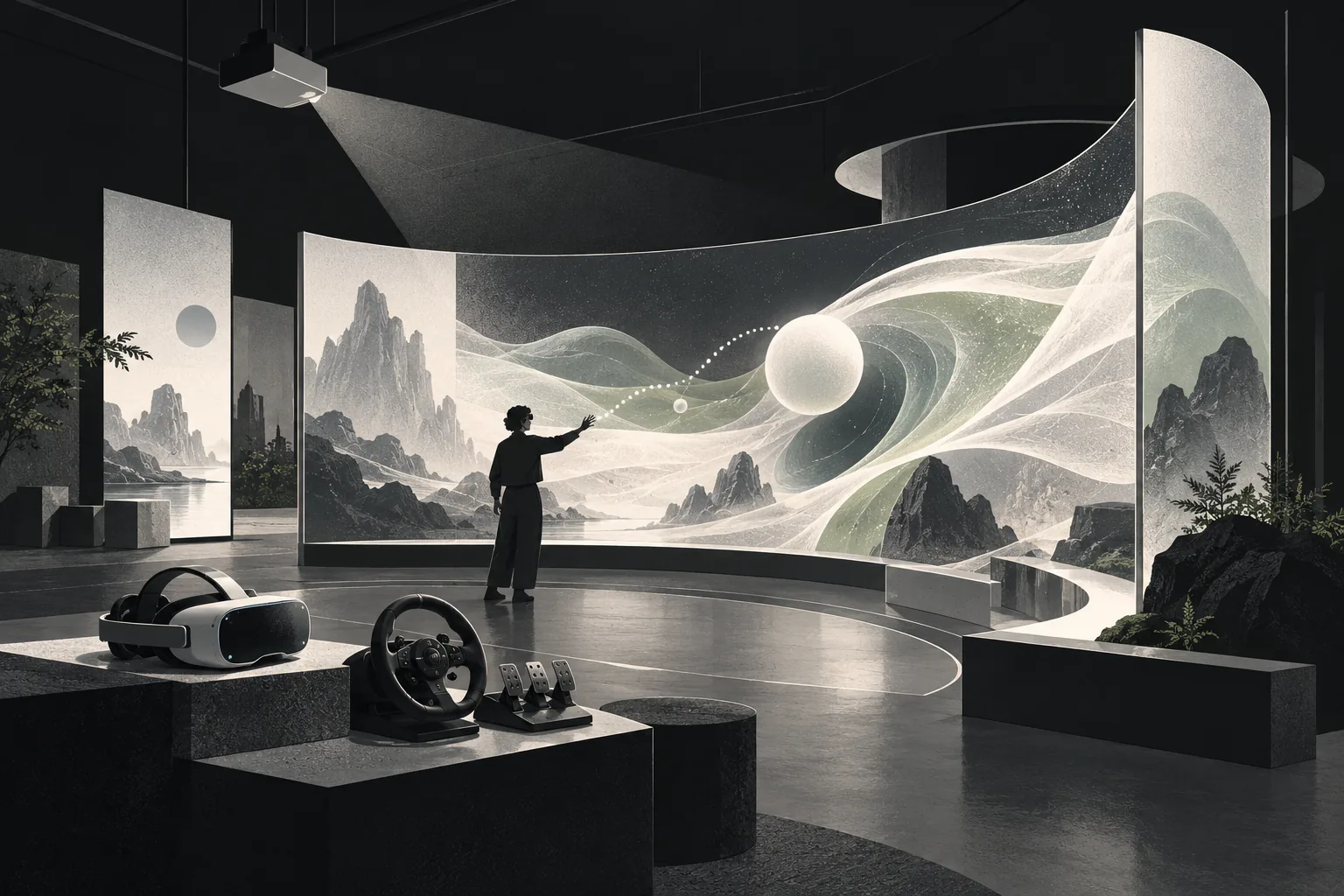
For teams building new experiencesWe research, prototype and build 3D experiences across screens, spaces and physical systems.
Anamorphic 3D billboard video is one of those capabilities: content built for a specific screen and viewpoint, not a generic 16:9 advert reused from another job.
01 / Capabilities
For teams building new experiences01
Content built for the exact geometry of a screen, so depth reads from the street.
02
Imagery fitted to buildings, objects and stages.
03
Experiences for headsets and phones, from prototype to release.
04
Physical systems people can sit in, touch and control.
05
Lightweight 3D that runs in the browser.
06
Testing an idea in small, working steps before committing to the full build.
02 / Selected work
All work →Research · Prototype · Working installation
Anamorphic 3D for an LED display
03 / Starting your project
Useful details, not a checklistDescribe what someone should see, feel or do. The screen, space and physical constraints help shape the first prototype.
An anamorphic (naked-eye 3D) billboard is an optical illusion. The image is built for one viewing position, so that from that spot objects appear to sit in a volume or come out of the screen; from anywhere else the picture looks stretched. Media owners describe the same idea as anamorphosis or forced perspective, and they stress that the vantage point has to be chosen before the content is designed. We use it as a production method, not as a claim about a named campaign.
How the geometry works. A corner, or L-shaped, screen is typically two LED faces that meet at an angle — often a right angle on the outside corner of a building. In the 3D scene those two faces become two sides of a virtual box, and the camera sits at the agreed sweet spot, at real-world height and distance, looking toward the corner. A curved or single-sided screen uses the same idea with one face; a flat screen seen straight on can still show depth with a fake frame, but the pop-out is usually weaker. The media owner should also say how the seam is handled, and whether the two faces play as one file or as two synced files.
What we need before we build. Exact pixel resolution and physical size, the angle of each face, pixel pitch if it is known, where people will stand or drive past, and photographs from that spot. Refresh rate and whether the player can run 60 fps, plus the file type the player accepts, should come from the owner’s specification. JCDecaux’s 3D Effect Guide lists those items as the starting brief for this kind of work.
Typical phases (schedule confirmed after the brief). There is no standard duration — complexity and the number of screens decide the calendar. A useful way to plan the work is: (1) brief and screen specification; (2) viewpoint and site photographs; (3) a 3D model of the screen and a camera at the sweet spot; (4) look-development and an animatic from that camera; (5) full animation inside the virtual box; (6) projection or unwrap to the screen’s pixel map; (7) preview from the sweet spot and from off-angles; (8) delivery masters and an on-site check of brightness and contrast. Anamorphic fitting is extra work on top of a normal commercial: field measurements, a screen-specific layout, and the distortion pass. We do not quote a fixed number of days here.
Delivery formats. The display file has to match the screen’s native pixel map. On direct-view LED, content should be made at the display’s exact resolution rather than scaled from a generic HD frame — that is the Out of Home Advertising Association of America (OAAA) guidance for this kind of screen. Many networks still also ask for a 16:9 or 9:16 master, commonly 1920×1080 or 1080×1920. Public DOOH guides commonly ask for MP4, often H.264, sometimes MOV; some tables also allow Apple ProRes for the master. Sample OAAA tables use 29.97 fps; other buyer guides describe 30 fps as a standard rate, and some LED players can run 60 fps — the player’s specification wins. Spot lengths of 8, 10, 15 or 30 seconds are widely listed; JCDecaux notes that a 3D “splash” needs at least 10 seconds, and that 15 to 30 seconds is a comfortable length on large screens. Many loops run silently unless the site has agreed audio. Corner screens may need one unfolded file or two synced files. We also deliver a flat cut for social or TV, which is a separate render, not the anamorphic file cropped.
A file that has already been warped for one screen cannot be played as-is on another. The 3D scene can be re-fitted and re-rendered for a new geometry and viewpoint. We confirm the exact codec, container, frame rate, canvas size and audio policy in the brief.
Updated November 2026.
Sources: OAAA, Digital Out of Home Creative & Content primer (2019); OAAA PSA creative specifications (2025); Broadsign, DOOH specs guide; JCDecaux, 3D Effect Guide (2023); Ocean Outdoor on DeepScreen templates and vantage points (2021).
04 / Research & collaboration
Discuss an idea →Yes. Research and prototyping can help establish what to build and how the experience should work.
Our tractor simulator combined software with physical controls, working with an external engineer. The content, software and engineering responsibilities are defined for each project.
It depends on scope: the number of assets or shots, the level of detail and the delivery formats. We send a quote after reviewing your brief and bill in USD by milestone.
It depends on scope; we confirm a schedule after the brief. Larger projects are split into milestones so you can review progress along the way.
Depending on the project, we deliver engine builds, Unity or Unreal project files, real-time assets (FBX, glTF, USDZ) or display-ready video. We confirm the exact formats in the brief.
You officially own the final files once payment clears. Null Station keeps the right to show the work in its portfolio.
Yes. Null Station LLC works remotely with clients in the US, the UAE and Singapore, as well as worldwide.
Pixel resolution, physical size, whether the screen is flat, curved or a corner (and the angle of the faces), and the main viewing position, with photographs from that spot if possible. Pixel pitch, refresh rate, whether 60 fps is possible, and the file type the player accepts should come from the media owner. Then your brand assets, any product 3D or CAD, and the campaign message.
A master at the screen’s native pixel size, plus whatever container the player requires — often MP4 (H.264), sometimes MOV, with a higher-quality master such as ProRes when the owner asks for it. Frame rate follows the player: public DOOH guides commonly use 30 or 29.97 fps, and some LED screens accept 60 fps. We confirm the exact specification in the brief rather than assuming a generic 1920×1080 file will be scaled to fit.
A corner screen is two faces meeting at an angle, usually so both faces are seen from one sweet spot on the diagonal. The 3D model has to include both faces and that angle, and the owner should say whether they play as one file or two synced files. A flat screen can still show depth, often with a false frame, but the sense of an object leaving the building is usually stronger on a corner or a curve.
Brief and specs, viewpoint photographs, a 3D screen model and camera, look-development, animation, unwrap to the pixel map, preview, then delivery and an on-site check. There is no standard duration; we confirm a schedule after the brief. Fitting the illusion to a specific screen is extra work on top of a normal commercial.
Follow the media owner’s slot. Public DOOH guidance commonly lists 8, 10, 15 or 30 seconds. One media-owner guide suggests at least 10 seconds for a scripted 3D action, and 15 to 30 seconds as a comfortable length on large screens. We also make a separate flat cut for social or TV when you need it.
05 / Start a conversation
business@nullstation.coTell us what you’re building, and what you need it to do.